Archives: <span>Courses</span>

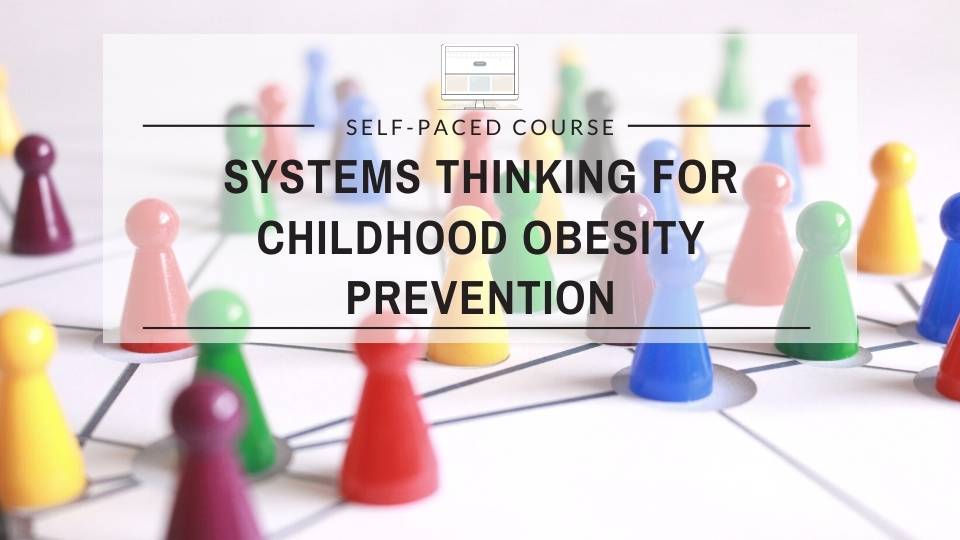
Systems Thinking for Childhood Obesity Prevention

Systems thinking is an approach to solving complex problems promoted by researchers and policy makers.  This training guides you through taking a systems approach to childhood obesity prevention, and presents ways to think about evaluating your approach.

Learning Objectives:

  1. Explain how to identify critical leverage points within a system.
  2. Explain methods for evaluating effectiveness of systems approaches.
  3. Practice taking a systems approach for childhood obesity prevention.

Learning Outcome:

Implement and evaluate systems approaches to childhood obesity prevention.

Target Audience:  Public Health Professionals

Duration: 30 min.

Continuing Education Information: 0.5 Category 1 CHES Credits, 0.5 Continuing Competency

Disclosures:  There are no declared conflicts of interest

Format: Web-based Training, Self-Study

Created: Nov. 2019

Author: Allison Root, MS, RD

Public Health Learning Navigator Quality Seal

Advance Care Planning to Improve Patient Care

This presentation will help attendees understand the importance of Advanced Care Planning.

Learning Outcomes:

  • Analyze the importance of Advance Care Planning (ACP) for all competent individuals over the age of 18 and the appropriate documents to support wishes for care.
  • Apply practical knowledge of the proper use of Advance Directives and/or Provider's Orders for Life Sustaining Treatment (POLST).
  • Gain understanding and confidence in initiating and facilitating ACP conversations by using resources and tools presented.

Target Audience: Public Health Professionals

Duration: ~ 1.5 hours

Continuing Education Information: 1.5 CECH for CHES, 1.5 CPEUs for RDs

Format: Web-based Training, Self-Study

Created/Updated: October 11, 2019

Author(s)/ Presenter(s): Hope Young, Advanced Care Planning Coordinator, Kokua Mau

Behind the Headlines: What is Really Happening with Opioid Use and Treatment in Hawai’i

Use of opioids such as heroin, morphine, and prescription pain relievers has expanded to levels of dependency in many individuals. Several factors contribute to the breadth and complexity of this urgent problem: severe chronic pain, greater use of prescriptions, aggressive marketing by pharmaceutical companies, among others. Updates about treatment, services, solutions, and resources exist here in Hawai‘i to reduce harm and improve quality of life for all.

Learning Outcomes

  • Identify approved medications to treat opioid use disorder.
  • Discuss opioid intervention and updates about management of opioid use disorder.
  • Appropriately refer patients to resources and services to treat opioid-dependent clients in Hawai‘i.
  • Appropriately coordinate care for patients that are opioid dependent.

Target Audience: Nurses, Pharmacy Professionals, Substance Use Professionals

Duration: ~ 1.5 hours

Continuing Education Information: 1.5 Category 1 CHES Credits, 1.5 Continuing Competency Credits

Format: Web-based, Self Study

Original Webinar Recorded: September 20, 2019

Author(s) and Presenter(s): Heather Lusk, MSW and Christina Wang, DNS From Hawai‘i Health and Harm Reduction Center

Episode 2: Shifting the Focus of Women’s Health from Procreation to Gynecologic Issues

Join Dr. Leslie Farland and Kelly Heslin as they discuss research, awareness, and funding surrounding women’s health issues, particularly focusing on disparities and barriers to care for women with endometriosis.

Leslie Farland, ScD, focuses her research on women’s health, particularly looking at the intersection between women’s reproductive health and chronic disease risk; etiology and risk factors for endometriosis, infertility, and polycystic ovary syndrome; and disparities in access to infertility care and fertility treatment utilization.

Kelly Heslin is a Senior Research Specialist and certified health education specialist at the College of Nursing at the University of Arizona, currently working on skin cancer prevention research. Her diagnosis of endometriosis at age 22 led to her participation in local and statewide advocacy and support efforts. 

Learning objectives:

  1. Identify reasons for the poor awareness and diagnosis of endometriosis.
  2. Discuss solutions for improving the screening and recognition of endometriosis by healthcare providers.
  3. Define the role of the public health workforce in advocating for and normalizing conversations around gynecologic health.

Continuing Education Information: 0.75 CECH for CHES

CHES Provider number:  99036

Date Released: 9-11-19

Episode 1: Creating Environments that Prevent Sexual Aggression

Join Dr. Elise Lopez and Erica Freese as they discuss cultural, social, and environmental issues related to sexual aggression, including bystander education, communication strategies, and adaptation of interventions.

Elise Lopez, DrPH, MPH, is the director of the University of Arizona Consortium on Gender-Based Violence. Her work examines the design, implementation, and evaluation of interventions related to sexual violence, sexual health, adolescent substance abuse, and trauma-informed care.

Erica Freese, MPH, is the Program Coordinator of the Advanced Nursing Education - Sexual Assault Nurse Examiner Program, a HRSA-funded program to expand sexual assault response services in rural areas.

Learning Objectives:

  1. Discuss strategies used by the Safer Bars Alliance to mitigate the normalization of sexual aggression and non-consent, particularly environmental strategies.
  2. Examine the role of communication in implementing public health programs that address sexual violence.
  3. Explain the importance of adapting public health interventions to address the needs of different contexts and populations.

Continuing Education Information: 0.75 CECH for CHES

CHES Provider number:  99036

Date Released: 9-5-19


A Community Response to Hoarding Disorder

Join Lisa O'Neill, DBH, Associate Director of Research and Education for the University of Arizona Center on Aging, to discuss health and safety issues, assessment tools, and treatment options related to Hoarding Disorder. Curriculum topics and facilitation tips learned from the HOPE Workshop, a 10-week facilitated workshop for people struggling with hoarding behaviors, will be identified.

Learning Outcomes:

  • Discuss the psychological experience of acquiring and discarding material goods for individuals with Hoarding Disorder.
  • Describe key health and safety issues related to a hoarding environment.
  • Identify critical curriculum topics and facilitation tips for community-based workshops for adults struggling with hoarding behaviors.
Target Audience:  Public Health Professionals

Duration:  ~ 1 hour

Continuing Education Information:  1.0 CECH for CHES

Created/Updated:  July 23, 2019

Presenter(s):  Lisa O'Neill, DBH

Vaping 101

This presentation will help attendees orient to the current youth vaping epidemic in Hawai‘i.


Learning Outcomes

  • Compare national, state and local Hawai‘i youth vaping rates.
  • Educate health professionals on the top three reasons why youth use electronic smoking devices (ESDs).
  • Educate the public on the health implications in youth vaping. 
  • Address the youth vaping epidemic with health professionals and community leaders.
  • Discuss potential health impacts of vaping and recent changes in ESD technology that increase the vulnerability of youth to ESD use and nicotine addiction.

Target Audience:  Public Health Professionals

Tier(s) and Competency Domain(s):  Tiers 1 and 2, Analytical/Assessment, Communication, and Community Dimensions of Practice Skills

Duration:  ~ 1.5 hrs.

Continuing Education Information:  This training is approved 1.5 hrs for CHES/MCHES, 1.5 CPEUs for RD/RDN/DTR (8/2022)

Format:  Web-based Training, Self-Study

Webinar Recorded:  August 9, 2019

Author(s) and Presenter(s) Forrest Batz, PharmD, Retired Faculty, Daniel K Inouye College of Pharmacy, University of Hawai'i at Hilo

The Restless Mind: Finding Peace and Support in a Busy World

Worry and distress are feelings that many people feel occasionally when faced with potential harm.  Others may live with more chronic anxiety about upcoming events in their lives by feeling tension and ongoing nervousness. Anxiety can cause distress and un-ease in dealing with everyday life.  Many different ways exist to gain more ease, improve anxious feelings and/or even prevent anxiety. 

Learning Outcomes:

  • Review the definitions of anxiety, stress, and trauma.
  • Examine the symptoms of anxiety including the impact of anxiety on health and the factors that can affect stress.
  • Identify assessment and screening tools for anxiety with linking referral resources for support and treatment
  • Evaluate the importance of self-care and how to use self-care tips to mediate stress.

Target Audience:  Allied Health Professionals, Mental Health Professionals, Public Health Professionals

Tier(s) and Competency Domain(s):  Tier I- Analytical/ Assessment Skills, Communication Skills; Tier II- Analytical/Assessment Skills, Communication Skills

Duration:  ~1.5 hours

Continuing Education Information: 1.5 Category 1 CHES Credits, 1.5 Continuing Competency

Format:  Web-based Training, Self-Study

Webinar Recorded:  July 12, 2019

Author(s) and Presenter(s):  Mestisa C. Gass, PsyD ,​Program Director of Mental Health America of Hawai‘i

Dr. Mestisa C. Gass, PsyD, is the Program Director for Mental Health America of Hawaii. She graduated with a Master’s and Doctorate degree, in Clinical Psychology, from Argosy University. Her education and experience has been focused on diverse populations including inpatient acute adolescent care, community mental health, and military mental health. Her training and work has emphasized diversity and trauma focused care. She is a certified trainer for the MHAH’s Youth Suicide and Bullying Prevention Training for Trainers (T4T) curriculum. She worked as a clinician/therapist for the past fifteen years in the South and now in Hawaii. She has been in Hawaii since 2006, being originally from the Appalachian Mountains. She is passionate about bringing education, support, and resources to all communities, especially rural areas like those in which she was raised.

Professional Ethics Guiding Decision-Making In Dementia Care

Professional ethics can be a code of principles and well as represent how healthcare professionals handle their conduct with best standards and informed decisions.  Professional ethics can be viewed as the best benefit for both the health professional and the client and especially for dementia clients. There are good guiding principles to utilize while engaging in the process of sound ethical decision making.

Learning Objectives:

  1. Examine what is meant by professional ethics for healthcare professionals
  2. Discuss guiding principles and examples of good ethical decision making
  3. Review recommendations in dealing with dementia clients with professional ethics and sound ethical decision making outcomes

Continuing Education Information: 1.5 CHES


Almost done!

One More Step:

Check your email to confirm your subscription to join us

Stay up to date with WRPHTC News!

Sign Up for our Newsletter

Subscribe to the WRPHTC newsletter for updates!