Archives: <span>Courses</span>

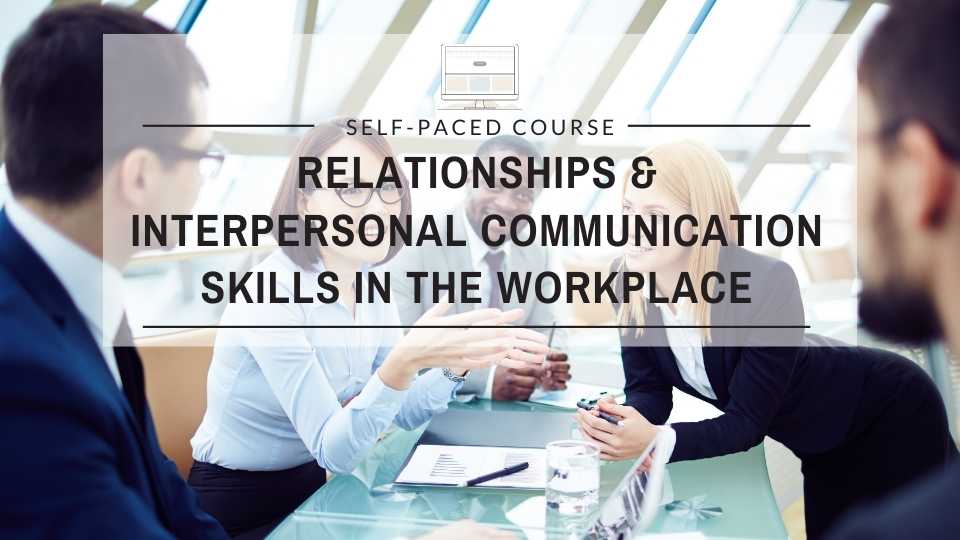
Relationships and Interpersonal Communication Skills in the Workplace

Almost all activities in the workplace take place in the context of relationships. Relationships are built and maintained, bettered or worsened, through communication. Interpersonal communication skills are core competencies for those who are in charge to accomplish the work of the organization. This training will focus on communication and relationships between supervisors and supervisees in behavioral health organizations. Participants will learn components of, and tools for, effective communication to help support successful relationships in the workplace.

Learning Objectives:  

  • Identify appropriate active listening techniques to use in the workplace
  • Discuss the importance of communication in building and maintaining relationships among supervisors and supervisees in behavioral health organizations
  • Identify and use effective conflict management techniques in the workplace
  • Discuss cultural and generational differences at work and identify techniques to improve cooperation and understanding across cultures and generations

Target Audience:  Managers and Supervisors

Duration:  ~ 45 min

Continuing Education Information:  0.75 Category 1 Credits for CHES, 0.75 Continuing Competency Credits

Disclosures:  The planners, reviewers, and authors have no declared conflicts of interest

Format:  Web-based Training, Self-Study

Created/Updated:  July 2020

Author(s)/ Presenter(s):  Michael Dues, PhD, Mary Brown, PhD, Caitlin Meyer Krause, MPH

Arranged by:  Caitlin Meyer Krause, MPH; Instructional Specialist

Crisis & Emotional Intelligence: A Family Perspective

This presentation will discuss crisis intervention, emotional intelligence and how to work with patients in crisis.

Learning Objectives:

  1. Learn what crisis intervention means and how it is applied within our community
  2. Identify and learn some coping skills to put into your toolbox
  3. Learn how to communicate during a crisis
  4. Define emotional intelligence and identify aspects of it within themselves
  5. Discuss aspects of emotional intelligence within themselves and others

Target Audience: Community Health Workers, Dietitians, Social Workers, General Public Health Staff

Duration: 90 minutes

Continuing Education Information: 1.5 CECH for CHES, 1.5 CPEU for RDs, 1.5 CNEs for RNs

This educational activity is jointly provided by the Western Region Public Health Training Center and the University of Arizona Continuing Nursing Education.

University of Arizona Continuing Professional Education is an approved provider of continuing nursing education by the Continuing Nursing Education Group, an accredited approver by the American Nurses Credentialing Center’s Commission on Accreditation.

Un

CHES Provider number:  99036

CPEU Provider number: 21216

Disclosures:  The planners, reviewers, and authors have no declared conflicts of interest 

Format: Recorded Webinar

Originally Recorded: 5/2020

Presenter:   Anisa Wiseman, NAMI Hawaii 

The health risks of vaping for teens webinar by 808novape

This presentation will introduce statistics on the vaping epidemic and share education on the harmful effects that vaping has on our youth.

Guest Speaker: Kevin Ramirez, Youth ESD Prevention Project Coordinator, Hawai‘i Public Health Institute

Learning Objectives:

  • Compare national, state and local Hawai’i youth vaping rates
  • Educate the public on the potential health impacts of youth vaping
  • Address the recent changes in ESD technology that increase the vulnerability of youth to ESD use and nicotine addiction
  • Examine current resources that exist for youth vaping cessation

CE Information:  1.5 CECH for CHES

Disclosures:  There are no conflicts of interest to disclose.


Unidas en Prevención: Formas en que las Promotoras(es) Pueden Apoyar la Prevención de COVID-19

  • Describir las causas probables, la propagación y los síntomas del nuevo coronavirus
  • Aclarar los mitos y rumores actuales sobre COVID-19Citar respuestas de expertos médicos
  • Usar las habilidades escritas en las Competencias básicas de Promotores de Salud del Departamento de Servicios de Salud para disipar mitos y rumores
  • Incluir aspectos culturas para la prevención y tratamiento de COVID-19

Utilizing Palliative Care and Navigating the Our Care Act

This presentation will help attendees understand palliative care and learn about the Our Care, Our Choice Act.

Learning Objectives:

  1. Define Palliative Care and who benefits from Palliative Care
  2. Define the distinctions of Palliative Care and Hospice and when referrals are appropriate
  3. Review the process for the Our Care Our Choice Act for medical aid in dying

Continuing Education Information: 1.5 CECH for CHES; 1.5 CPEU for RDs

CPEU Accredited Provider number:  21216

CHES Provider number:  99036

2019 Novel Coronavirus: An Information Session

View the recording from a panel discussion of experts from the University of Arizona's College of Public Health, Campus Health, Banner Health, and the Maricopa and Pima County Health Departments demystifying the 2019 Novel Coronavirus. 

Objectives:

  1. Foster better understanding of the 2019-nCoV outbreak using epidemiologic principles.
  2. Share reliable information and information sources regarding risk, prevention, diagnosis, and treatment from WHO, CDC, ADHS, Pima County Health Department, and UA Campus Health.
  3. Promote evidence-based preventative strategies.

Mental Health Mini-Talks

A series of mini-talks on mental health topics by experts in the field.

Learning Objective:

  • Describe various topics that can impact our mental health.

Target Audience: Allied Health Professionals, General Public Health Professionals, Mental Health Professionals, Nurses, Sociologists, Others

Tier(s) and Competency Domain(s): Tier I- Communication Skills, Cultural Competency Skills, Community Dimensions of Practice Skills; Tier II- Communication Skills, Cultural Competency Skills, Community Dimensions of Practice Skills

Duration: ~ 1 hour

Continuing Education Information: None

Format: Web-based Training, Self-Study

Created/Updated: January 29, 2020

Author(s)/Presenter(s): Amy Munoz, DBH; Jennifer Carlson, PhD; Hilary Mahoney, MPH; Melissa Flores, PhD; Lisa Kiser, DNP; Diego Piña Lopez, MSW, MPA

Community-Based Policy Development: Lessons from the Field

Merrill Eisenberg will help public health advocates understand the policy making process at the state and local levels and to use this understanding to plan policy action to benefit the public's health.

Learning Objectives:

This training was create to assist public health workers navigate policy change. At the end of this training, learners should be able to:

  • Distinguish between public health and health care policy.
  • Describe the policy process in local policy making.
  • Define the "Three Streams" theory of policy making.
  • Determine potential policies to address community health problems.
Target Audience:

Community Health Workers, Food System Workers, Policy Advocates and Policy Makers

Duration: 32 minutes

Format: web based/self study

Continuing Education: 0.5 Category 1 CHES Credits, 0.5 Continuing Competency

Created/updated: 10/2017; 2/2020

Author and Presenter: Merrill Eisenberg

Public Health Learning Navigator Quality Seal

Writing a personal budget: strategies and connections to health

Do you want to improve your personal finances or help others improve theirs? This training will provide you with tools to create a personal budget and identify ways to improve your financial health.  The training also provides information about health behavior theory as it relates to improving financial health and background information about financial health and stress.  We also present ideas for incorporating budgeting trainings into public health programs.

Learning Objectives

1.  Describe the negative effects of financial stress.

2.  Apply health behavior theory to personal financial health.

3.  Create a personal budget and identify ways to improve personal financial health.

4.  List public health programs that may incorporate personal budgeting concepts as part of health promotion.

Continuing Education:  0.5 Category 1 Credits for CHES, 0.5 Continuing Competency Credits

Duration: ~30 min

Created/Updated: March 2020

Author:  Allison Root, MS, RD


Adolescent Obesity Prevention in Schools

In the United States, the percentage of adolescents affected by obesity has more than tripled since the 1970s.  A comprehensive approach incorporating nutrition and physical activities in schools best supports the health and well-being of adolescents.  This training will review physical activity and healthy eating guidelines for adolescents and how they can be implemented in schools to promote health.


Learning Objectives:

  1. Discuss the prevalence of adolescent obesity in the U.S.
  2. ​Discuss the ​components of MyPlate.
  3. Communicate recommendations for physical activity for adolescents.
  4. Demonstrate ways to improve "seat time" at school for adolescents.
  5. Describe policies that promote adolescent obesity prevention.

Duration:  ~ 30 minutes

Continuing Education Information:  0.5 Category 1 CHES Credits, 0.5 Continuing Competency Credits

Created/Updated:  2/2020

Author(s):  Marisa Parra, Monica Lowry, Allison Root, MS, RD


Almost done!

One More Step:

Check your email to confirm your subscription to join us

Stay up to date with WRPHTC News!

Sign Up for our Newsletter

Subscribe to the WRPHTC newsletter for updates!