Archives: <span>Courses</span>

Composing a Scientific Paper

This module aims to help you organize your information and synthesize your work for presentation in a public health scientific paper. It details essential topics such as formatting, and it discusses strategies such as critical thinking that can facilitate good writing.

Learning Objectives:

By the end of this module, you will be able to:

  • List the required section titles of a scientific paper.
  • Utilize strategies and tools to compose the main body of a scientific paper.
  • Utilize appropriate writing styles to synthesize content.
  • Identify tools for organizing literature review studies. 
  • Explore citation styles.

Target Audience:  Public health professionals and students

Duration:  50 minutes

Continuing Education Information: 1.0 Category 1 CHES Credits, 1.0 Continuing Competency

Format:  Web-based Training, Self-Study

Disclosures:  The planners, reviewers, and authors have no declared conflicts of interest

Created/Updated: October 2020

Author: Douglas Taren, Ph.D.; Professor of Public Health  

Dr. Taren is Editor-in-Chief for Nutrition Reviews, who works with a team that reviews cutting edge research for its readers, including nutrition scientists, biomedical researchers, clinical and dietetic practitioners, nutrition decision-makers, and advanced students of nutrition. Dr. Taren is a retired Deputy Director of the MPH program at the University of Arizona and has served as the Associate Dean for Academy Affairs. He has received several extramural grants (R25, USAID, and HRSA) to create and evaluate training programs and to fund public health projects. One of the factors that have brought together Dr. Taren’s research and public health interests together is creating the training programs for graduate students and the public health workforce that translate science to public health practice.

Arranged by: Dipanwita Das, M.Sc., M.A., ID, OD

Identifying a Research Question

This module introduces the concept of critical thinking and the 4Cs rule. Utilize this skill to identify a research question for a study or project. It also introduces the types of research questions and the research approach. 

Learning Objectives:

By the end of this module, you will be able to:

  • Identify the purpose and components of a scientific paper.
  • Utilize critical thinking to identify a research question.
  • Utilize appropriate language to present the research question.
Target Audience: Public health professionals and students. 

Tier(s) and Competency Domain(s):  Tier I- Analytical/ Assessment Skills, Communication Skills

Duration: 20 minutes

Continuing Education Information:  0.5 Category 1 CHES Credits, 0.5 Continuing Competency

Format:  Web-based Training, Self-Study

Disclosures:  The planners, reviewers, and authors have no declared conflicts of interest

Created/Updated: October 2020

Author: Douglas Taren, Ph.D.; Professor of Public Health  

Dr. Taren is Editor-in-Chief for Nutrition Reviews, who works with a team that reviews cutting edge research for its readers that include nutrition scientists, biomedical researchers, clinical and dietetic practitioners, nutrition decision-makers, and advanced students of nutrition. Dr. Taren is a retired Deputy Director of the MPH program at the University of Arizona and has served as the Associate Dean for Academy Affairs. He has received several extramural grants (R25, USAID, and HRSA) to create and evaluate training programs and to fund public health projects. One of the factors that have brought together Dr. Taren’s research and public health interests together is creating the training programs for graduate students and the public health workforce that translate science to public health practice.

Arranged by: Dipanwita Das, M.Sc., M.A., ID, OD


UArizona Student Ambassador Model: Crushing COVID-19 through Peer Education

The goal of this module is to provide an understanding of the purpose and structure of the student ambassador program at the University of Arizona and the leadership responsibilities student ambassadors have to stop the spread of COVID-19.


At the end of this module, the learner will be able to:

  1. Describe the purpose of a student ambassador model.
  2. Apply inclusive communication techniques to educate peers about COVID-19 prevention practices.
  3. Understand strategies to utilize and share accurate information on social media with peers to mitigate the spread of COVID-19.
  4. Illustrate the leadership role student ambassadors will fulfill within the UArizona community to stop the spread of COVID-19.

Designing a Public Health Poster

A poster is a common communication tool in academia used to represent your work through a combination of brief text and graphics, supplemented by an oral presentation. Posters are widely used at conferences and universities to summarize research, programs,  and other initiatives. This short training will provide a quick overview of tools and strategies to design an engaging poster.

Learning Objectives:

  • Define the purpose of a poster.
  • List essential content to include in a poster.
  • Describe best practices in poster layout and design.

Target Audience:  Public health professionals and students

Duration:  30 minutes

Continuing Education Information:  0.5 Category 1 CHES Credits, 0.5 Continuing Competency

CHES Provider number:  99036

Format:  Web-based Training, Self-Study

Disclosures:  The planners, reviewers, and authors have no declared conflicts of interest

Created/Updated: September 2020; Updated August 2022.

Author: Douglas Taren, Ph.D., Professor of Public Health, Editor-in-Chief for Nutrition Reviews  

Arranged by: Dipanwita Das, M.Sc., M.A., ID, OD

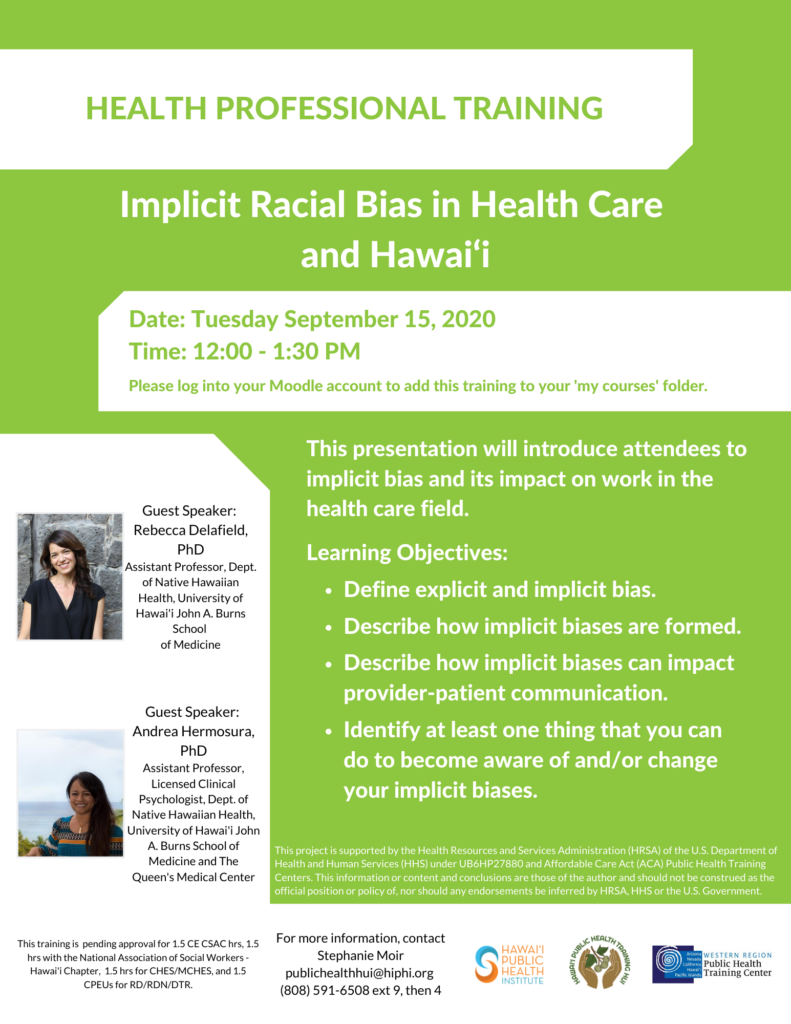
Implicit Racial Bias in Health Care and Hawai‘i

Attendees will learn about implicit racial bias in health care and Hawai‘i and how its effect on communities. 

Learning Objectives:

1. Define explicit and implicit bias.

2. Describe how implicit biases are formed.

3. Describe how implicit biases can impact provider-patient communication.

4. Identify at least one thing that you can do to become aware of and/or change your implicit biases.


Communicating with parents and caregivers about weight

Positive interactions with families to discuss their child’s health can make the difference in promoting positive change, improving health, and reducing overweight and obesity. Sometimes these conversations can be difficult or may feel uncomfortable. Building communication skills can help reduce discomfort and improve confidence in communicating with families about their child’s weight and overall health. This training will discuss communication strategies, and provide the opportunity to practice conversations through simulated case examples.  


Learning Objectives

  1. Practice principles for effective communication: trust, active listening, positive psychology, and a strength-based approach.
  2. Adjust communication strategies based on stages of change or readiness to change.
  3. Utilize communication tools including growth charts and other visual aids.
  4. Explore the idea of cultural safety as it relates to communication.

Target Audience: Public Health Professionals

Duration: 1.0 hour

Continuing Education Information: 1.0 Category 1 CHES Credit, 1.0 Continuing Competency

CHES Provider number:  99036

Disclosures:  The planners, reviewers, and authors have no declared conflicts of interest 

Format: Web-based training, Self Study

Originally Created: 10/2020

Arranged by:  Allison Root, MS, RDN; Instructional Specialist


The Zuckerman College of Public Health Contact Tracing Program

The Zuckerman College of Public Health Contact Tracing Program is a 7-module training for Contact Tracers in the State of Arizona. This course covers; an introduction to contact tracing, epidemiology of COVID-19, communication skills, the Incident Command System, the Medical Electronic Disease Surveillance Intelligence System, and the economics of contact tracing, and the State politics of a pandemic.


After completing this course, you will be able to effectively perform the duties and responsibilities of a contact tracer with a working understanding of the systems, tools, and policies with contact tracing.


Episode 18: Addressing Wicked Problems in Public Health: Climate Change

Dr. Mona Arora and Dr. Andrew Comrie join us this week to discuss complex or "wicked" problems in public health, looking specifically at climate change and the elements like communication and policy change needed to effectively address these issues.

Learning Objectives

    • Describe One Health and why it is important for public health

    • Discuss communication strategies within the climate change discussion

    • Discuss the importance of policy changes surrounding climate change, including not letting the pandemic overshadow the focus of climate change for a healthy future

Continuing Education Information: 0.75 CECH for CHES

Duration: 46 min.

Provider number: 99036

Date Released: 7/2020


Professional Development for Supervisors

Professional development and continual learning is critical to developing new skills, staying up-to-date on best practices, and advancing careers. This training will review techniques to motivate, guide, and develop staff. Participants will learn of workforce development opportunities to guide employees within behavioral health organizations.

Learning Objectives:

  • Recognize the importance of motivating employees and identify appropriate methods of motivating employees
  • Describe the most successful approaches for guiding employees and expanding their knowledge and skill levels
  • Identify personal strengths and areas of improvement and know who and how to ask for help when needed

Target Audience:  Mid-level supervisors

Duration:  45 minutes

Continuing Education Information:  0.75 Category 1 CHES Credits, 0.5 Continuing Competency

Format:  Web-based Training, Self-Study

Created/Updated:  October 2020

Author(s)/ Presenter(s):  Michael Mandel, MBA

Arranged by:  Caitlin Meyer Krause, MPH; Instructional Specialist

Leadership for Supervisors

Leadership skills better equip people to influence others to develop new skills, realize their potential, and work collectively toward a common goal. This training will focus on building and strengthening leadership skills for mid-level supervisors. Participants will learn what makes an effective leader and techniques for managing work, problem solving, and critical thinking that help support supervisors in behavioral health organizations.

Learning Objectives:  

  1. Identify various leadership strategies to improve team performance
  2. Describe ways to facilitate change in the workplace 
  3. Apply successful methods for managing the work of employees

Target Audience: Mid-level supervisors

Duration: ~ 45 minutes

Continuing Education Information: 0.75 Category 1 CHES Credits, 0.75 Continuing Competency Credits

Disclosures:  The planners, reviewers, and authors have no declared conflicts of interest

Format:  Web-based Training, Self-Study

Created/Updated:  September 2020

Author(s)/ Presenter(s):  Kenneth Schachter, MD, MBA

Arranged by:  Caitlin Meyer Krause, MPH; Instructional Specialist

Almost done!

One More Step:

Check your email to confirm your subscription to join us

Stay up to date with WRPHTC News!

Sign Up for our Newsletter

Subscribe to the WRPHTC newsletter for updates!