Archives: <span>Courses</span>

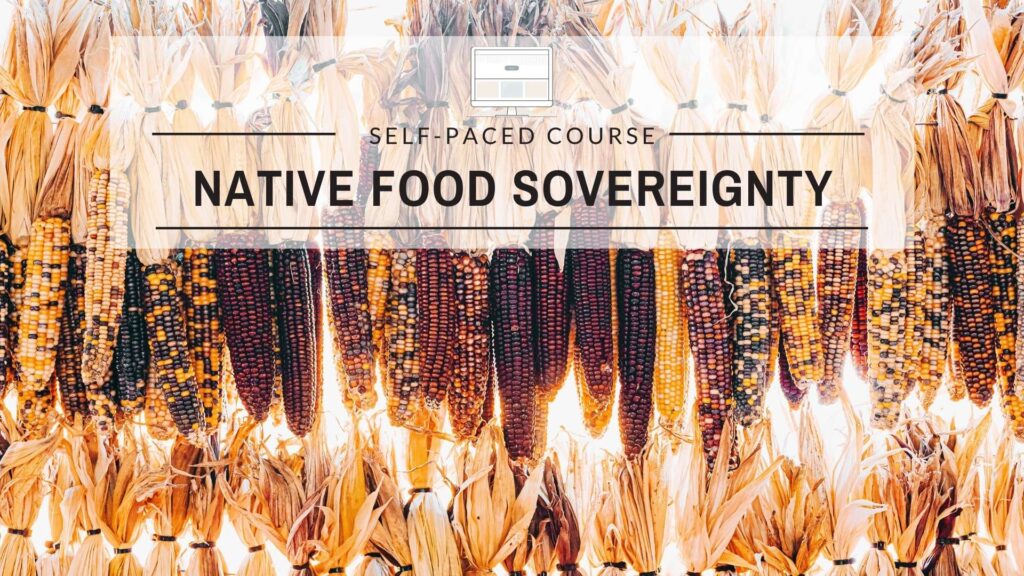
Native Food Sovereignty

Environmental factors and federal policies have had a large impact on the health and cultural identity of our Indigenous populations.  With increasing rates of diabetes, obesity, and cancer in Native American communities, strengthening Native food systems offers an opportunity to improve Native economies, health, and culture. This course is meant to give an overview of how health departments and public health workers can help strengthen Native food sovereignty, for the purpose of improving Native health and revitalizing Native cultures.


Learning Objectives:

  • Identify contributing factors to the high prevalence of diet-related diseases in Native Americans.
  • Introduce how to use a Food Sovereignty Assessment to identify a community’s food system assets.
  • Identify funding sources for projects aimed at strengthening Native food sovereignty.
  • Explain how tribal food policies can be used to strengthen Native health.
  • Provide examples of how knowledge of Native foods can be used to improve food sovereignty.

 Target Audience:  Dietitians, Policy/ Planner, General Public Health Staff, Public Health


Duration:  ~ 45 minutes


Continuing Education Information: 1.0 Category 1 CHES Credits, 1.0 Continuing Competency


CHES Provider number:  99036

Disclosures: The planners, reviewers, and authors have no declared conflicts of interest

Format: Web-based Training, Self-Study


Created/Updated:  3/15/2017; 11/3/2021


Author(s):  Abigail Stoica, MPH


Presenter(s): Jennifer Richards, DrPH candidate


Public Health Learning Navigator Quality Seal

Motivational Interviewing

Motivational Interviewing is a communication technique that helps empower patients to make desired behavior changes to improve their health. It has been used effectively by professionals to guide changes in many different contexts, including smoking cessation and weight loss. Available literature demonstrates the use of motivational interviewing in patients with diabetes significantly enhances adherence to treatment recommendations and weight loss efforts. This training will get you familiar with the concept of motivational interviewing in the context of weight management.

Si el español es su idioma preferido, puede tomar la versión en español de este curso aquí.

Learning Objectives:

  • Describe the key concepts and steps in motivational interviewing
  • Demonstrate ways to lead a client through the steps of motivational interviewing
  • Describe how using motivational interviewing can produce better results with patients than other instructional or interviewing methods.

Target Audience: Allied Health Professionals, Dietitians, Physicians and Other Clinicians, Social Workers, General Public Health Staff

Duration: 30 minutes

Continuing Education Information: 0.5 Category 1 Credits for CHES, 0.5 Continuing Competency

CHES Provider number:  99036

Format: Web-based training, Self Study

Created/Updated: 8/2021

Author(s):  Randa Kutob, MD, MPH; Allison Root, DrPH, RDN

Disclosures:  The planners, reviewers, and authors have no declared conflicts of interest

Public Health Essentials in Action

Look at the most fundamental aspects of public health to break down the overarching goals and strategies of the field. You'll gain an understanding of the Three Public Health Core Functions and the Ten Essential Public Health Services* as a framework for the responsibilities of local public health systems, and how this framework serves to improve health equity.

Si el español es su idioma preferido, puede tomar la versión en español de este curso aquí.

*This training has been updated to align with the revised version of Essential Public Health Services. 

Learning Objectives: 

  1. Define public health. 
  2. List the social determinants of health. 
  3. Recognize the three Public Health Core Functions. 
  4. Identify ways each of the Essential Public Health Services works to improve health equity.
  5. Identify the role your work plays in public health.

Target Audience: Educators/Trainers, General Public Health Staff

Course Duration: ~60 minutes

Continuing Education Information: 

  • Continuing Education Contact Hours for Certified Health Education Specialists (CHES): This program is designated for Certified Health Education Specialists (CHES®) and/or Master Certified Health Education Specialists (MCHES®) to receive up to 1.0  total Category I continuing education contact hour (1.0 continuing competency credit). WRPHTC provider number 99036.

  • Continuing Professional Education Units for Dietitians (CPEUs): As a Jointly Accredited Organization, the WRPHTC is approved to offer continuing professional education units by the Commission on Dietetic Registration. The WRPHTC designates this activity for 1.0 contact hour for dietitians. Dietitians should enter activities as type 102 on their Activity Log.

  • 1.0 ANCC credit for Nurses

Accreditation Statements


The WRPHTC is jointly accredited by the Accreditation Council for Continuing Medical Education (ACCME), the Accreditation Council for Pharmacy Education (ACPE), and the American Nurses Credentialing Center (ANCC), to provide continuing education for the healthcare team.
 

The Western Region Public Health Training Center (WRPHTC) is a Designated Multiple Event Provider of Continuing Education Contact Hours (CECH) for Certified Health Education Specialists (CHES) through the National Commission for Health Education Credentialing, Inc.

Format: Self-Study

Updated: Dec. 2025

Author(s): Ray Andrade, Ed.D; Sana Khan, MPH; Abby Stoica, MPH, Allison Root, DrPH, RDN, MCHES

Arranged by: Dipanwita Das, M.Sc, M.A., ID, OD, Six Sigma BB; Allison Root, DrPH, RDN, MCHES

Narration: Erich Healy

Disclosures:  The planners, reviewers, and authors have no declared conflicts of interest

PHLN Certified Quality Seal

Caring for Infants with Neonatal Abstinence Syndrome and Mothers with Opioid Use Disorder

This course aims to expand foundational knowledge for using non-pharmacological approaches when caring for infants with Neonatal Abstinence Syndrome (NAS) and working with mothers with Opioid Use Disorder (OUD) in hospital settings.

It covers three topics relevant to working with infants with NAS and mothers with OUD. Learners will gain an understanding of 1) NAS and its long-term effects, 2) Trauma-informed approaches to care, and 3) Medication-assisted recovery for mothers with OUD. 

Learning Objectives

  1. Communicate the current recommendations for long-term monitoring of infants with NAS.
  2. Describe the prevention interventions that can help mitigate any potential long-term effects of NAS.
  3. Communicate the current science on potential long-term health and educational outcomes for infants with NAS.
  4. Practice using terms and preferred language to help reduce stigma and discrimination around substance use and recovery.
  5. Describe SAMHSA’s three E's of Trauma: Events, Experience, and Effect of trauma.
  6. Explain how health care settings can apply Trauma-Informed Care (TIC) principles.
  7. Discuss common misconceptions about medication-assisted recovery and strategies to address them.
  8. Communicate national guidance for managing pregnant and post-partum women with OUD.

Target Audience: Clinical and non-clinic health care professionals working with infants with NAS and mothers with OUD. 

Core Competencies for Public Health Professionals: Tier 1 – Front Line Staff/Entry Level and Tier 2 – Program Management/Supervisory Level.

Duration:  60 minutes

Continuing Education Information: 1.0 Category 1 CHES Credits, 1.0 Continuing Competency Credits

CHES Provider number:  99036
 

Format:  Web-based Training, Self-Study

Created/Updated:  July 2021

Author(s):  Yvonne Bueno, MPH, OTR/L, Mohammed Bader, MD, Lisa Grisham, NNP-BC, Jocelyn Maurer, RNC-NIC

Disclosures:  The planners, reviewers, and authors have no declared conflicts of interest

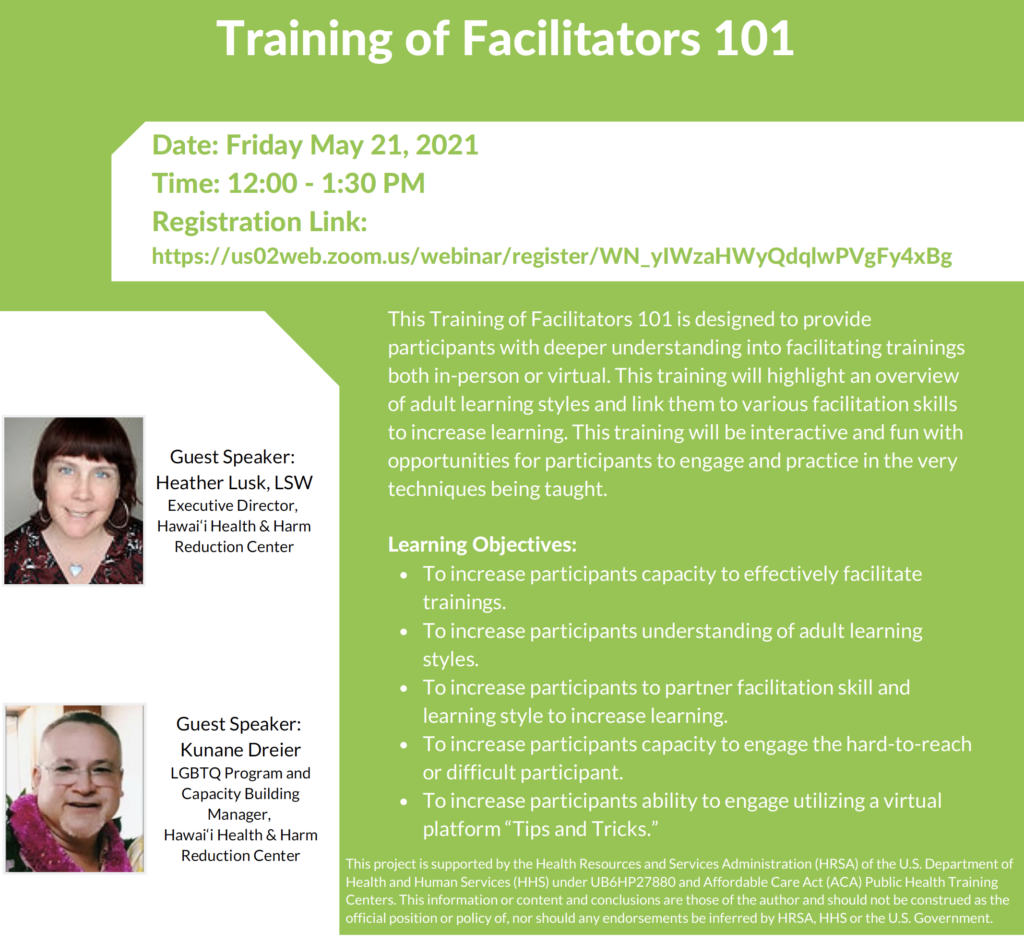
Training of Facilitators 101

This Training of Facilitators 101 is designed to provide participants with deeper understanding into facilitating trainings both in-person or virtual. This training will highlight an overview of adult learning styles and link them to various facilitation skills to increase learning. This training will be interactive and fun with opportunities for participants to engage and practice in the very techniques being taught. 

Learning Objectives

  • To increase participants capacity to effectively facilitate trainings.
  • To increase participants understanding of adult learning styles.
  • To increase participants to partner facilitation skill and learning style to increase learning.
  • To increase participants capacity to engage the hard-to-reach or difficult participant.
  • To increase participants ability to engage utilizing a virtual platform “Tips and Tricks.”

Target Audience: Public Health Professionals including health educators, registered dietitians, social workers and others.

Duration:  90 minutes

Continuing Education Information: 1.5 CECH for CHES

CHES Provider number:  99036
 

Format:  Recorded Webinar

Created: May 2021

Author(s):   Heather Lusk, LSW Executive Director, Hawai‘i Health & HarmReduction Center, Kunane Dreier LGBTQ Program and Capacity BuildingManager, Hawai‘i Health & HarmReduction Center

Disclosures:  The planners, reviewers, and authors have no declared conflicts of interest

Breathe & Let Go: Mindful Forgiveness as a Daily Living Skill to Live Life on Purpose

The Mindful Forgiveness workshops is a professional development training designed to teach & promote mindfulness and forgiveness as foundational daily living skills using two research based tools: “Forgive for Good” by Dr. Fred Luskin and “Mindfulness in Daily Living” by Dr. Thao Le. Participants will be introduced to concepts, tools and practices that will allow them to implement a daily mindfulness practice and learn the steps to the Forgive for Good process. Participants will leave with a better understanding of how to let go of unhelpful thinking and be freer to have a more productive relationship with coworkers, family members and clients.

Learning Objectives

  • Participants will practice 3 ways to cultivate mindfulness
  • Participants will be able to identify the 7 steps to forgiveness
  • Participants will be able to identify the importance of the embodied practice of these steps

Target Audience: public health professionals including health educators, registered dietitians, social workers and others.

Duration:  90 minutes

Continuing Education Information: 1.5 CECH for CHES

CHES Provider number:  99036
 

Format:  Recorded Webinar

Created/Updated: 7/2021

Author/Presenter:  JoYi Rhyss, Director, Mindful Forgiveness Center and Chief Executive Officer, MoxieFitness, LLC

Disclosures:  The planners, reviewers, and authors have no declared conflicts of interest

Weight Management During and After Pregnancy

Excess weight gain during pregnancy and excess weight retained after pregnancy can contribute to lifelong development of obesity and increasing cycles of obesity and diabetes in mothers and children.  This training reviews body mass index (BMI), prevalence of obesity in women, health consequences of excess weight in pregnancy, guidelines for weight management during and after pregnancy, and components of effective community-based postpartum weight loss programs. 

Learning Objectives

  1. Define overweight and obesity in pregnancy and recommended weight gain guidelines.
  2. Define overweight and obesity in the postpartum period and safe weight loss recommendations.
  3. Identify health risks associated with excess weight gain in pregnancy and retaining weight after pregnancy.  
  4. Evaluate components of effective community-based postpartum weight loss programs.  

Target Audience: public health professionals including health educators, registered dietitians, nurses, and health program planners.

Duration:  60 minutes

Continuing Education Information: 1.0 Category 1 Credits, 1.0 Continuing Competency Credits

CHES Provider number:  99036
 

Format:  Web-based Training, Self-Study

Created/Updated: originally created 6/2017; updated 7/2021

Author(s):  Allison Root, DrPH, MS, RDN

Disclosures:  The planners, reviewers, and authors have no declared conflicts of interest
Tools to Support Clients to Reduce Nicotine Dependency

Understanding the clinical pharmacology of nicotine provides a basis for improved nicotine dependency prevention and treatment. This course will help tobacco cessation coaches and specialists, nurses, medical and behavioral health practitioners gain profound knowledge of the addiction process and tools to support clients to quit smoking. The content of the course is applicable to e-cigarettes or vapes as well as conventional tobacco products. 

Learning Objectives

By the end of this training, you will be able to:

  1. Define the process of nicotine dependency
  2. Describe the biological, psychological, and socio-cultural chain of addiction
  3. Identify patients' level of nicotine dependency.
  4. Understand the “Stages of Change” model to assess patients' readiness to reduce tobacco use
  5. Utilize tools to help motivate a patient to reduce nicotine dependency

Target Audience: Tobacco cessation coaches and specialists, nurses, medical and behavioral health practitioners

Duration: 90 minutes

Continuing Education Information: 1.5 Category 1 CHES credits, 1.5 Continuing Competency Credits

CHES Provider number:  99036

Format:  Web-based Training, Self-Study. 

Created/Updated: June 2021

Author(s): 

Mark Boldt, Director, Tobacco Cessation Training Institute.

Judith S Gordon, Ph.D. Associate Dean, Research Member of the Graduate Faculty. Professor, BIO5 Institute. Professor, Family and Community Medicine. Professor, Nursing.

Arranged by: Dipanwita Das, Senior Instructional Designer. 

Disclosures: The planners, reviewers, and authors have no declared conflicts of interest 
Microaggressions: Transforming the Mindsets of Adults Working with Students

Take a dynamic look at microaggressions from a youth and student perspective and examine how microaggressions affect rapport building with adults. Learners will gain understanding in how youth may respond to microaggressions and action steps to how youth-serving professionals can transform these negative instances into a more affirmational approach. This course will also touch upon strategies to better communicate with youth and students.  

Learning Objectives:

  • Define and describe microaggressions with youth in mind 
  • Reflect on everyday examples of microaggressions
  • Recognize what microaggressions look and sound like 
  • Interrupt microaggressive behavior 
  • Transform microaggressions into a more strengths-based approach
  • Practice microaffirmations in scenario-based learning

Target Audience: Youth-serving professionals (i.e. program planners, program/case managers and policymakers), youth mentors, and educators 

Course Duration: ~45 minutes 

Continuing Education: 0.75 Category 1 CHES Credits, 0.75 continuing competency credits

Author: Robert Clark

Introduction to Data Visualization

Data visualizations make data easier to understand for people like policy makers, journalists, and community members. This training provides an introduction to data visualization, why it is important in public health, and how to identify the proper type of visualization for the data you’re examining through examples and scenario-based exercises.

Learning Objectives

  • Define data visualization 
  • Discuss why data visualization is important for public health
  • Identify various settings and styles of data visualizations
  • Identify types of data visualizations and when to use each one

Target Audience: Public health professionals, public health students, health departments

Duration: 1 hour

Continuing Education Information:  1.0 Category 1 CHES Credit, 1.0 Continuing Competency Credits

CHES Provider number:  99036

Format:  Web-based Training, Self-Study 

Created/Updated: May 2021

Author(s): Caitlin Meyer Krause, MPH

Arranged by:  Caitlin Meyer Krause, MPH

Disclosures:  The planners, reviewers, and authors have no declared conflicts of interest 
Almost done!

One More Step:

Check your email to confirm your subscription to join us

Stay up to date with WRPHTC News!

Sign Up for our Newsletter

Subscribe to the WRPHTC newsletter for updates!